Jake Silverstein
Co-founder & CEO
After nine years as a tech recruiter, guiding engineers through big career decisions, Jake now runs Tellbrief and built the product, from the conflict check to the finished brief.
LinkedIn ↗Answer plain questions about what’s changing in your business, like a first retail deal, a raise or your first hire. Tellbrief turns them into a brief you keep, and during early access a corporate lawyer reads every one.
A national retailer wants our products in 40 stores by spring, and they sent us their vendor agreement. Our formula came from a contract manufacturer, and I’m not sure who owns it.
We’re raising our first outside money this month. An angel investor sent us a SAFE, and my co-founder and I never put our split in writing.
We’re hiring our first employee, who starts next month. We offered a salary and some equity. Until now two freelancers built our app, and the new hire will work from another state.
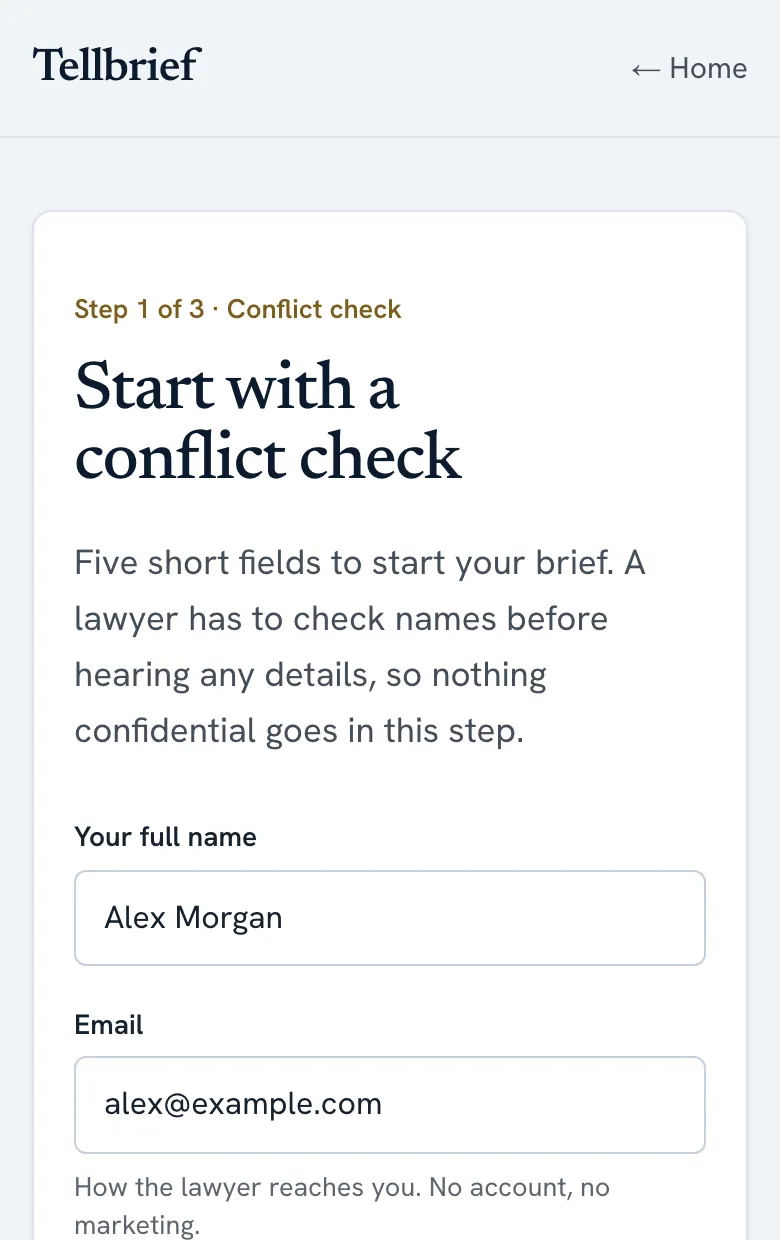
Names, your email and what it’s about. A lawyer checks them against existing clients before you share anything confidential.
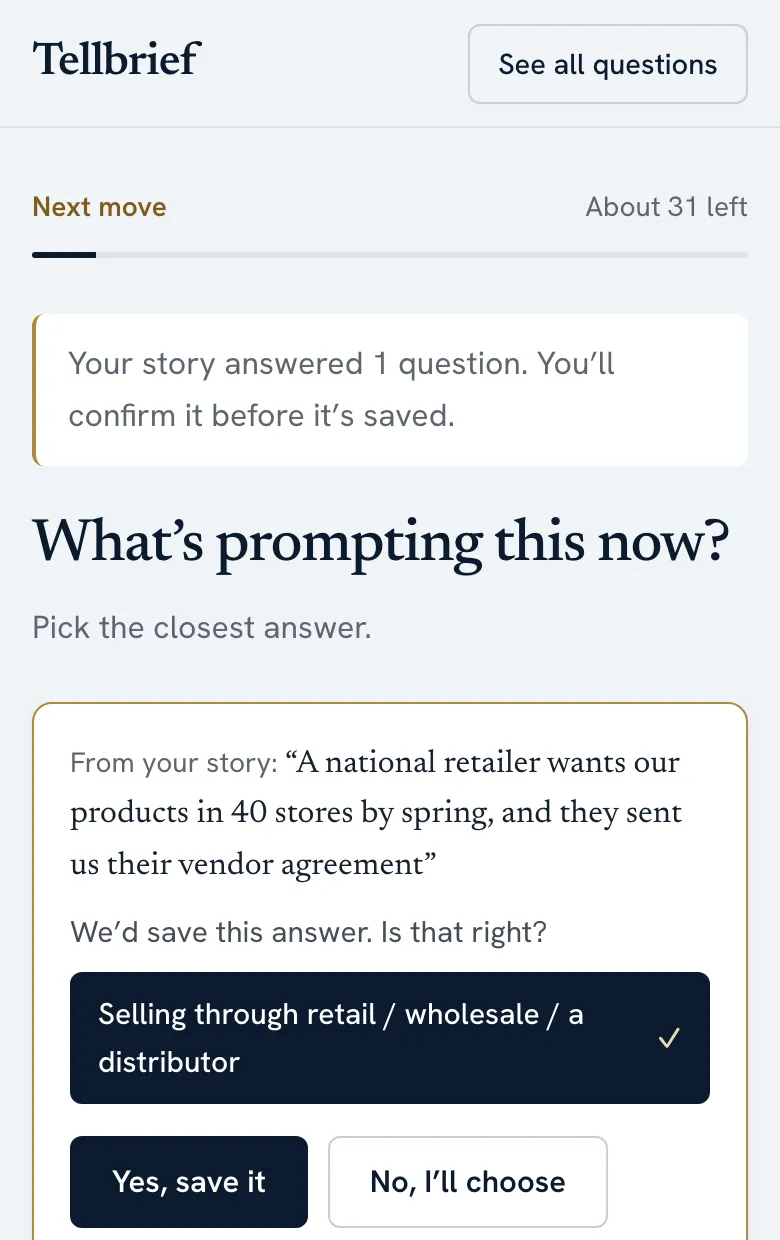
About 30 questions that fit your business, and most take one tap. Describe what’s happening and Tellbrief can suggest answers. You confirm each one.
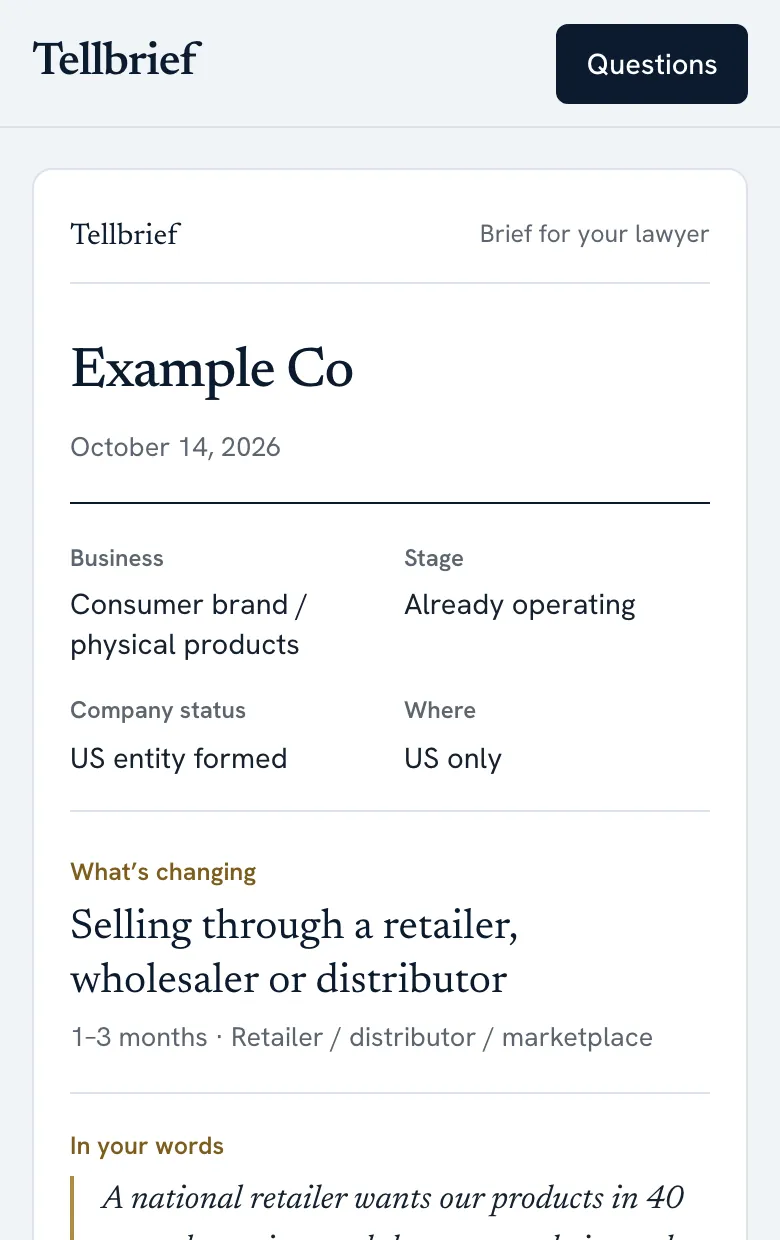
You see the whole brief before it goes anywhere, and you keep the PDF. The lawyer gets the same record.
Then The lawyer reads your brief and tells you whether he can take it on. If he can, you agree on the scope and his fee before any work starts. Either way, the brief is yours to take to any lawyer.
Lawyers billed an average of $378 an hour for business formation and compliance work in 2025.1 If yours bills by the hour, every minute spent on the basics is on your bill. Your brief covers the basics, so the call can start with questions like these, picked from your own answers.
At the 2025 average of $378 an hour.1 Your lawyer’s rate and billing may differ.
For example: Not formed yet, using a brand name, and collecting customer details.
For example: Selling by signed agreement, with renewals, and some work made by outside people.
For example: A retailer’s terms on the table, a contract manufacturer, a brand name and claims on the label.
For example: A first employee, after outside contractors built the early work.
For example: An investor’s offer in hand, ownership not written down, and equity already promised.
For example: A partner on the other side, a secret process, licensed software and a brand name.
For example: Founders who never settled ownership in writing, with some accounts in one founder’s name.
For example: A buyer on the other side, unclear contributor ownership, and assets in a founder’s name.
For example: A complaint from a supplier, with a hard deadline coming up.
See each situation in full: Launching · First customer · Retail deal · First hire · Raising money · Partnership · Founder split · Selling the company · A dispute · All situations
1. Clio, average lawyer hourly rates by practice area, 2025 (updated March 2026) (opens in a new tab). 2. Duane Morris Class Action Review, data privacy filings (January 2026) (opens in a new tab). 3. Benesch, automatic renewal compliance (September 2025) (opens in a new tab). 4. Orrick, starting as an LLC and QSBS (January 2026) (opens in a new tab). 5. 26 U.S.C. § 1202 (opens in a new tab). 6. Cal. Labor Code § 226.8 (opens in a new tab), California Legislative Information. 7. 18 U.S.C. § 1839(3) (opens in a new tab). 8. 26 U.S.C. § 83(b)(2) (opens in a new tab). 9. Federal Rule of Civil Procedure 12(a)(1)(A) (opens in a new tab). 10. 17 U.S.C. § 101, “work made for hire” (opens in a new tab). 11. 17 U.S.C. § 204(a) (opens in a new tab). Sources 5 and 7–11 are from the Cornell Legal Information Institute. General information, not legal or tax advice.
One page that sums up your situation, then every answer you gave. It’s yours to keep and to take to any lawyer.
Open a sample brief (opens in a new tab) PDF · made-up company
Brief for your lawyer · made-up company
Selling through a retailer, wholesaler or distributor
2–6 weeks · Retailer / distributor / marketplaceWhat should be in place before we sign the retailer’s vendor agreement?
Your copy. It isn’t legal advice and doesn’t create an attorney-client relationship.
A template gives you a document and a chatbot gives you an answer, but neither one knows your business or brings in a lawyer. Tellbrief gets your facts in order so a lawyer can advise you on your situation.
| Question | Document sites | AI legal chat | Law firm contact forms | Tellbrief |
|---|---|---|---|---|
| What you get | A document from a template | An answer from software | A form that goes to one firm | A brief you keep and can take to any lawyer |
| Who gives legal advice | Not the site; attorney add-ons cost extra | Software answers questions | That firm, once you hire it | Your lawyer, once you hire them |
| Names checked before you share details | No lawyer involved | No lawyer involved | Often, inside the firm’s software | Yes, first |
Tellbrief doesn’t draft documents or give legal advice.
After nine years as a tech recruiter, guiding engineers through big career decisions, Jake now runs Tellbrief and built the product, from the conflict check to the finished brief.
LinkedIn ↗Jordan is a lawyer with more than two decades of corporate experience, in-house and in private practice. He leads Tellbrief’s legal and compliance work.
LinkedIn ↗Tellbrief itself doesn’t give legal advice. The lawyer you hire does.
The privacy page lists everything Tellbrief keeps, sends and deletes.
Your answers stay in your browser tab until you send. If you talk, your browser turns it into text you approve. Tellbrief never receives audio.
If AI matches your words to an answer, you see it and confirm it. Notes it drafts for the reviewing lawyer must quote your answers, or they’re removed.
Conflict-check names and your brief are encrypted before they’re stored, each with its own key.
No ad trackers, analytics scripts or cookies.
Conflict-check records are scheduled for deletion 45 days after the last step on your check, and the lawyer’s review record 14 days after you send.
We don’t sell your information or use it for ads.
Free during early access. No card and no account.
Jordan reads your answers first. If he can take it on, he talks through the scope and his fee with you before any work starts.
No. Tellbrief organizes your information so the first conversation with your lawyer starts further ahead. It isn’t a law firm, and using it doesn’t make anyone your lawyer. Legal advice comes from a licensed lawyer, once they agree to take on your matter.
Your brief is free during early access, with no card and no account. If you’d like Jordan to take on the work, he reads your answers first, then talks through the scope and his fee with you before any work starts. Tellbrief takes no share of it.
During early access, Jordan Denning, Tellbrief’s co-founder and Chief Legal Officer, checks the names and reads every brief himself. He’ll tell you whether he can take your matter on. If he does, you agree on the work and his fee with him directly, and Tellbrief takes no share of it. Either way, the brief is yours to take to any lawyer.
You pick one at the start: forming the company, a customer or supplier contract, a retail or distribution deal, hiring, raising money, a partnership or license, ownership between founders, brand and IP, privacy and AI, a lease or location, buying or selling a business, a dispute, or a general cleanup. If yours doesn’t fit, choose “Other / not sure.”
About 30 questions once the names are cleared, and most take one tap. Plan on 10 to 15 minutes.
A lawyer has to check for conflicts before hearing the details. So the first step asks only for names, your email and what it’s about. The business questions open once the names are cleared.
Passwords, source code, customer lists, confidential formulas or messages with a lawyer. Tellbrief asks about your situation and never needs the documents themselves.
Either. Voice is optional: every question can be tapped or typed. If you do talk, your browser’s speech service turns it into text (in Chrome, that’s Google’s). You read and edit the text before anything is saved, and Tellbrief receives only the text you approve, never an audio recording.
No. AI can match your words to an answer, but you confirm it before it’s saved. Anything it drafts for the reviewing lawyer must quote your answers, or it’s removed. Your lawyer decides what matters legally.
Yes, one. You add it at the conflict check, so the lawyer has a way to reach you. There’s no account or password, and no marketing email. You get your finished brief as a PDF when you send it.
Names first. You share the details only after the lawyer clears them.
Start your briefFree during early access. No account and no marketing email.